N° 03 / 08 — SaaS · Voice AI
DeviJà
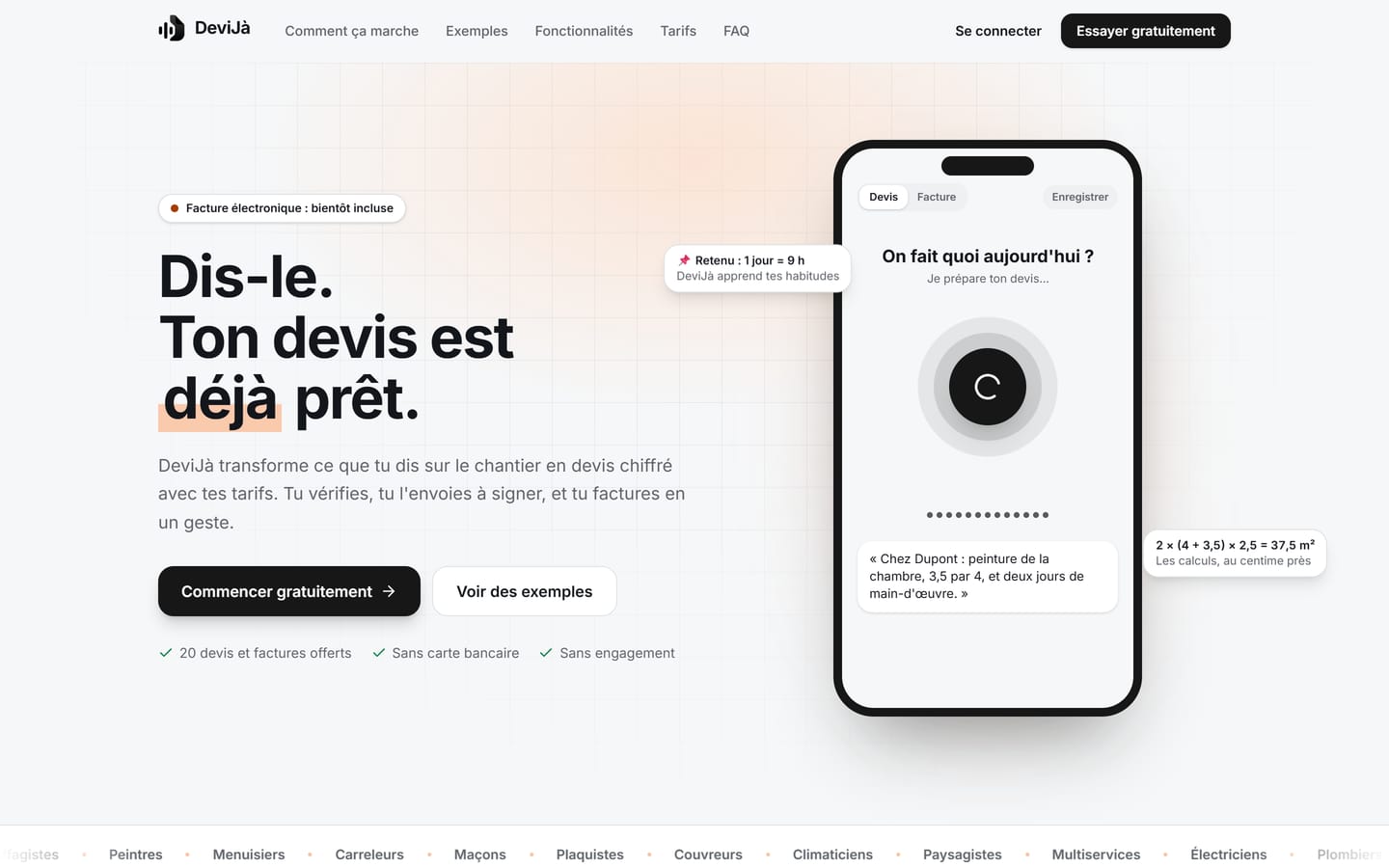
The quote writes itself while you talk: tradespeople dictate, DeviJà prices, sends and invoices.
- Role
- Design and development
- Year
- 2026
- Status
- LiveProfessional
- Stack
- Next.js · TypeScript · PostgreSQL · Prisma · OpenAI · Stripe
- Links
- Website ↗

01 / 07
The problem
A tradesperson spends their evenings redoing quotes and invoices, when everything is already in their head: the job, their rates, their habits.
And electronic invoicing between businesses is becoming mandatory, for people for whom this is not the job.
02 / 07
What I did
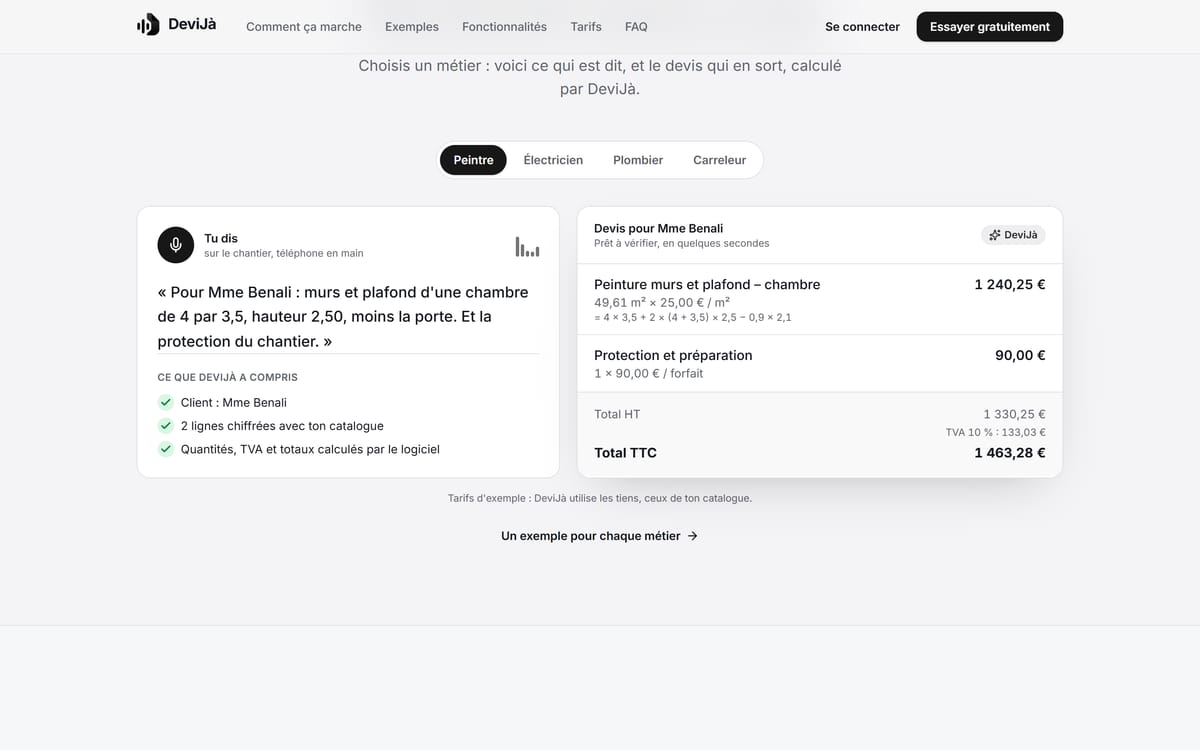
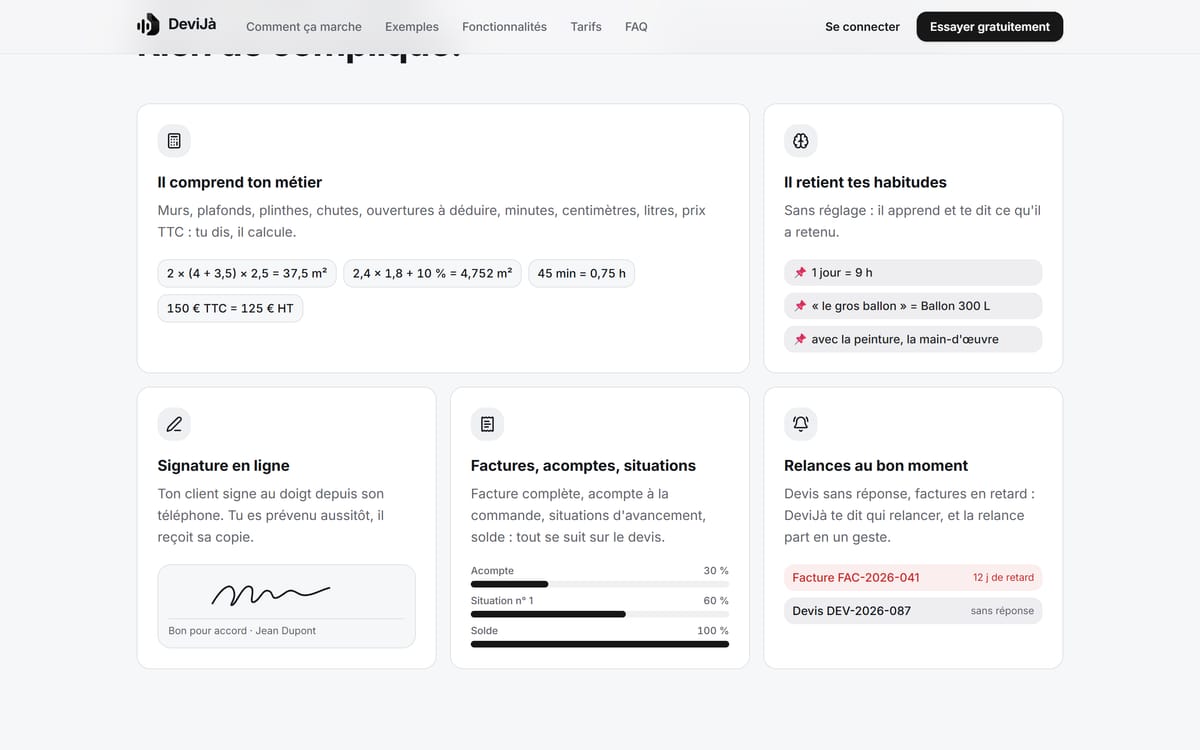
The tradesperson says what needs doing. DeviJà identifies the client and items, asks for what is missing, calculates the quote, generates the PDF and sends it with an online signature link. Invoicing then takes one gesture: full, deposit, progress payments, balance.
The assistant learns their habits (“1 day = 9 h”) and stops asking questions it already has answers to.
03 / 07
How it's built
The principle: AI understands, the software calculates and decides. No total, VAT rate or document number comes from the AI.
It is a Next.js PWA with business logic kept apart from the interface, on PostgreSQL and Prisma. OpenAI handles transcription and structured answers; PDFs and Factur-X are generated on the server.
- Dictation
- Understanding (OpenAI)
- Calculation engine
- PDF, signature, invoice
04 / 07
Challenges
- 01
Guardrails on the AI
The AI never provides a total, a VAT rate, a company ID or an invoice number, and never issues anything on its own. Each of its answers is structured and validated (Zod) before the calculation engine takes over.
- 02
Compliant e-invoicing
Invoices are generated on the server in the Factur-X format (PDF and XML), deposits, progress invoices and credit notes included, and checked with the Mustang validator.
- 03
An iPhone app, from the same code
The PWA becomes an iOS app with Capacitor (files, sharing, push notifications), built and published by Codemagic. The website is containerised with Docker and deployed by GitLab CI.
- 04
Getting known
SEO is part of the product: a page per trade, guides, JSON-LD structured data and generated Open Graph images. Even the video ads are written in code, with Remotion.
05 / 07
Results
DeviJà is live: 20 free quotes and invoices, then €14 a month or €140 a year, with no commitment.
An account is ready in 3 minutes, and clients and rates can be imported from Excel or CSV.
06 / 07
What I learned
On a legal document, you do not hand the arithmetic to a model. Strictly separating what the AI understands from what the code decides made the product reliable, and far easier to test.
07 / 07
Tech stack
- Front end
- Next.jsTypeScriptPWAZodTailwind CSS
- 3D, motion and real time
- Remotion (video as code)
- Back end and APIs
- StripeResend (email)Push notifications
- Data
- PostgreSQLPrisma
- Mobile
- CapacitorCodemagic
- AI
- OpenAI
- DevOps, cloud and testing
- DockerGitLab CI/CDGitVitest
- Product, SEO and methods
- Factur-X (e-invoicing)SEO
Next project · 04 / 08
JABS Software
JABS Software